My DIY Glitter Countertop!

DIY glitter countertop

You guys! I think all of the paint fumes around here are starting to get to me. I built a glitter countertop for our dining room. What could make that an even crazier prospect? Well, we are knee deep— no, make that eyeballs deep— in home renovations over here, and I decided it would be fun to build a glitter countertop right at the beginning of all the chaos! Phil and our dads are working on replacing the ant infested eaves of our home and also the gutters, while we’ve simultaneously been working on renovating our entire kitchen! So much good stuff for our house— so much bad stuff for my sanity. Anyway, amidst the planning for the new kitchen, I stumbled across a favorite antiques dealer of mine who was finally selling an old cabinet of his I had been eyeing for years! I had always sighed longingly at it when it was just an overstuffed display fixture at the antique mall, thinking about how perfect it would be to store all of my craft supplies out of sight in our dining room (my workspace). He gave me a deal for $300, so I immediately put it on layaway, then a month later brought it home.


The problem with the cabinet was, well… nothing as far as I was concerned. But I guess the fact that it had part of its front and all of its sides and top missing might have become an issue down the road. So I had to get out my saw and drill and finish the cabinet out with some new wood that completely clashed with the beautiful, old patina of the cabinet. It was a travesty, as you all bemoaned alongside me, but my friend Kyle helped me paint it a fresh coat of white, remove the broken glass knobs, and replace them with new ceramic ones. All it needed was a countertop!

I figured I could buy some lumber to frame out a new countertop similarly to our office countertop, so I headed off to the lumber yard. While I was there, inspiration struck. I thought— Hey, what if I made the countertop like a retro diner table top? Some funky laminate on top and aluminum banding around the edge? That would add the perfect amount of quirkiness to the beautiful antique cabinet! Of course, they didn’t have any laminate that fit the bill, nor any aluminum banding. So my DIY become a wee bit more complicated, but infinitely more fun! Did I tell you there were buckets of glitter involved?

DIY glitter countertopDIY glitter countertop

I built the countertop just as I had done in our office, and painted it a lemony yellow for an undercoat, in case any glitter didn’t cover certain spots, then the yellow would camouflage the mistakes. I’m glad I did that, because when I look closely at it now, I can see spots of that yellow paint showing through. After the countertop was built and painted, I got to work on the glitter. I decided to use an epoxy resin with glitter stirred in to give the countertop a durable finish with a transfixing, dimensional sparkle to it.

DIY glitter countertop

DIY glitter countertop

I used this epoxy resin which was a bit cheaper than others I had seen out there, and it worked great! To make the epoxy resin, you have to mix the resin with the hardener. The proportions must be exact, so I used plastic measuring cups that I could dispose of later. To begin, you mix equal parts of resin and hardener, stirring vigorously and constantly for four minutes. Then you transfer the mixture to a clean container and stir again for 4 minutes. Before stirring again, I quickly dumped the contents of my glitter bottle into the resin, then stirred.


DIY glitter countertop

DIY glitter countertop

After the last four minutes of stirring was complete, I poured the epoxy resin onto the countertop and spread it out with a wide painter’s edging blade. You supposedly have 20 minutes to work, but I found that it began getting tacky sooner than that, so I worked quickly.

DIY glitter countertop

Because I was planning on putting aluminum banding on the edge, I let the epoxy run over the edge. I wish I had covered it with duct tape, though, because I ended up having to sand away the drip marks to get my banding to sit flush with the edge of the counter. Duct tape would have just peeled off after about an hour or so of letting the resin set up, and then I wouldn’t have had any drip marks on the edge.

After spreading the resin, I sprinkled the top with glitter to cover any areas of yellow showing through. This prevented my epoxy resin from creating a shiny, glass-like surface, though, so the next day I decided to do another layer of epoxy resin and glitter. I’m so glad I did! It made all the difference.

Note: Do not pour your epoxy resin outside like I did! I got bugs in mine that I had to cut out with a blade. Most of the divets I made with the blade were filled in after the second coat of epoxy resin I did inside our house. But pouring inside was difficult because I had to make sure the toddler was nowhere to be found and that there was plenty of cardboard on the floor to catch drips.


DIY glitter countertop

Because our house was basically under construction, I left the countertop alone for about three weeks before working with it. It was a good idea to let it cure that long because of the two coats of resin I had done extended the curing time quite a bit. (I would set something onto the counter and have to pull hard to get it off because it was bonding with the resin!) So this week, the aluminum banding I had ordered from Outwater (ALU7777 on this page) came in, and Phil helped cut slits into the edge of the counter so we could attach the banding. We used a skill saw to cut the grooves and I applied construction adhesive to help the banding stay in place.

I love the way it turned out! The cabinet top is significantly higher than standard height (It originally was mounted as an upper cabinet/locker in an old store— hence the no sides or top thing.), so you can’t see the glitter until you are next to the cabinet, but you can see the beautiful aluminum banding, and I think it plays well against the more traditional feel of the cabinet itself.

DIY glitter countertop

It’s a nice surprise, though, when you go over to the cabinet to make a drink, and BAM! There’s a glitter countertop! Talk about a conversation starter!

http://www.outwatercatalogs.com/lg_display.cfm/catalog/Master_Catalog_Vol_42/page/37/highlight/brass%20ripple%20edge%20banding


http://www.outwatercatalogs.com/lg_display.cfm/catalog/Master_Catalog_Vol_42/page/37/highlight/brass%20ripple%20edge%20banding

Oh, and P.S. Maybe you’re not really into the idea of a glitter countertop or tabletop, but check it out! I made this abstract painting last week! It was my first time really attempting anything like this since art school, and even then, I had never done anything in this style. I shared my process over at A Beautiful Mess right here, and you can see how I framed it right here.

DIY Custom FramingI hope you all are doing well! I’m hoping to get back to more regular posting within the next week or so. Thanks for checking in on me! As always, you can see me in between posts here by checking out my updates at A Beautiful Mess!


Lately at A Beautiful Mess

Mandi Johnson at A Beautiful Mess

Lately I’ve been waking up in the morning, pinching myself, and getting right to work on my projects for A Beautiful Mess. Is this really my life? Pinch again. Back to work. Is this really work, though? Oh yeah, it’s work— but it’s the best kind! I’ve really enjoyed my recent projects, especially this mid century modern side table (above) and quilted wall art (below left).

Right now I’m working on a couple of easy-as-pie projects that I hope you’ll like as much as me, but while I wait for the paint to dry, I thought I’d share my recent projects with you in hopes that you’ll be inspired to make something fun for yourself!

Mandi Johnson at A Beautiful Mess

Mid Century Modern Table DIY // What a fulfilling project this was! I was surprised at how relatively simple it was to make, but I definitely feel like the process flexed my craftsman muscles and made me a more confident DIYer when I saw the beautiful end result.

DIY Quilted Modern Art // Inspired by the quirky graphic textile art of Ethan Cook, this art uses simple quilting techniques alongside tradition canvas stretching for an unexpected design element in our living room.

DIY Mid Century Inspired Plant Stand // I have some larger houseplants that needed a little boost off the ground, and this was the project was the perfect simple solution! 

Mandi Johnson at A Beautiful Mess

Make This Metallic Lightning Bolt Mobile // This was a really fun and whimsical project that would be perfect for a nursery or office space.

Vinyl Chair Makeover // People didn’t believe it was as easy as I described, or that it would hold up as well as it has— But I promise this is such a simple way to update an old vinyl chair, and it seems like the finish is going to wear really nicely through the years!Mandi Johnson at A Beautiful Mess

Wall-Mounted Jewelry Box Display // I love rescuing sad antiques and repurposing them in modern ways. This time was for a quirky little jewelry display in our powder room!

DIY Marquetry-Inspired Wooden Trivets // Got a craft blade and a hot iron? Then you can do this project! It’ll really add some pizazz to your dinner table and dress up the walls in between meals.
Mandi Johnson at A Beautiful Mess

Turn a Bird Cage into a Mod Floor Lamp // This project definitely upped the cool-factor of our living room. So easy, too! The funnest part was shopping for the bird cage stand. I was surprised as how many are for sale in antique malls and shops!

Try This: Type Tray Nail Polish Display // I always see a wide variety of type trays for sale at antique shops, and finally realized it would be perfect for nail polish display! After I finished this project I discovered my lipstick fits perfectly in the in between spaces too. Victory!Mandi Johnson at A Beautiful Mess

Simple & Sweet Donut Pillow // Finally— A calorie free way to enjoy doughnuts! This project is really simple, and a good one to make with a child’s assistance.

Try This: White Tablecloth Makeover // Tired of looking for a fun patterned tablecloth that suits your specific tastes? Quit looking and make your own!Mandi Johnson at A Beautiful Mess

Modern Mirror DIY // I wanted a bold, graphic mirror, and it was really easy to make one myself with some plywood, paint, and a jigsaw!

Make Your Own Faux Marble Drawer Knobs // Are you into the marble trend as much as I am? You might also be sad because marble is $$$, but you can fake the look pretty easily!

Mandi Johnson at A Beautiful Mess

Build a Mini Horse Bookcase // This folk-art inspired bookshelf adds the perfect amount of whimsy to Lucy’s bedroom. It would also make a nice stand for potted herbs too!

Spotted Curtains DIY // I can’t get enough of spots these days, and this set of curtains I made will look great in Lucy’s next bedroom!

Mandi Johnson at A Beautiful Mess

Make Your Own Pop Art Pet Portrait // This Andy Warhol inspired craft project is so incredibly easy to do! You don’t even need photo editing software.

Budget Curtain Rod & Finial DIY // Curtain hardware can be so expensive, but I made my own rod and modern finials for very little money! I was really pleased with how store-bought it looked when I was finished.Mandi Johnson at A Beautiful Mess

How to Create a Weathered Paint Effect // This easy rub-off weathering technique takes very little time and gives a great patina to any of your projects.

DIY Marble Jade Earrings and Pendant Necklace // Another simple jewelry DIY with lovely results! You won’t believe how easy they are to make.

Sew Your Own Custom Back-Wrap Top

Make your own sewing pattern for a custom wrap top. Step by step photos of sewing process included!

Ready to get your sew on? If you liked the back-wrap top I shared last week, then check it— I’m back with detailed instructions! I hope you won’t be too intimidated to give it a go. If you’re worried about making darts, you can start out with a knit fabric instead of something woven. And you don’t have to make it reversible, but then it would only be half the fun. Point is: You make the rules! If you do make your own, though, just do me one little favor. Link it up, babies!

Make your own sewing pattern for a custom wrap top. Step by step photos of sewing process included!

Make your own sewing pattern for a custom wrap top. Step by step photos of sewing process included!

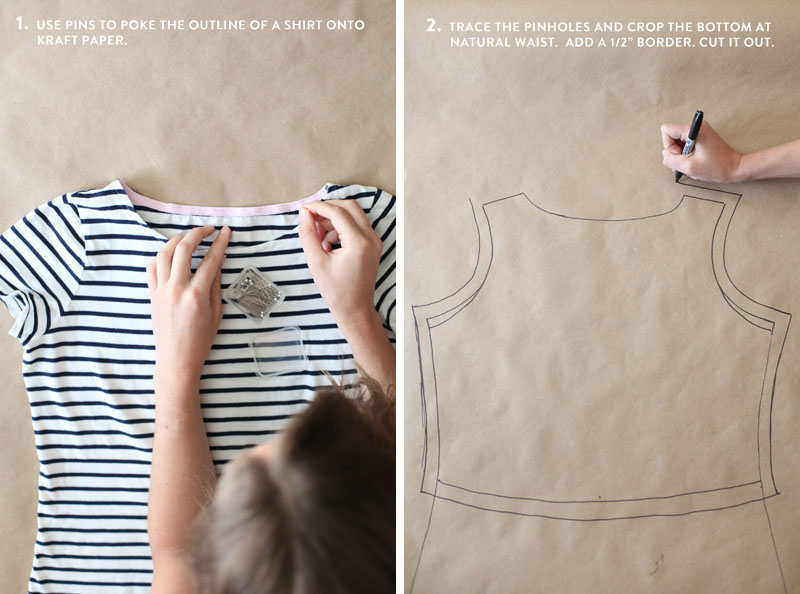
Step One: Find a shirt that fits closely (but doesn’t stretch) to your figure. Transfer its shape to a piece of kraft paper by poking holes along its border with straight pins. You may also chose to trace the shirt with a fabric pen.

Step Two: Trace the pinhole outline with a pen, cropping the shirt at its natural waist. It’s better to crop it longer than you may eventually want it and you can trim it down later. Add a 1/2″ border to the outline for hem allowance. Then Cut out the piece of paper.

Make your own sewing pattern for a custom wrap top. Step by step photos of sewing process included!

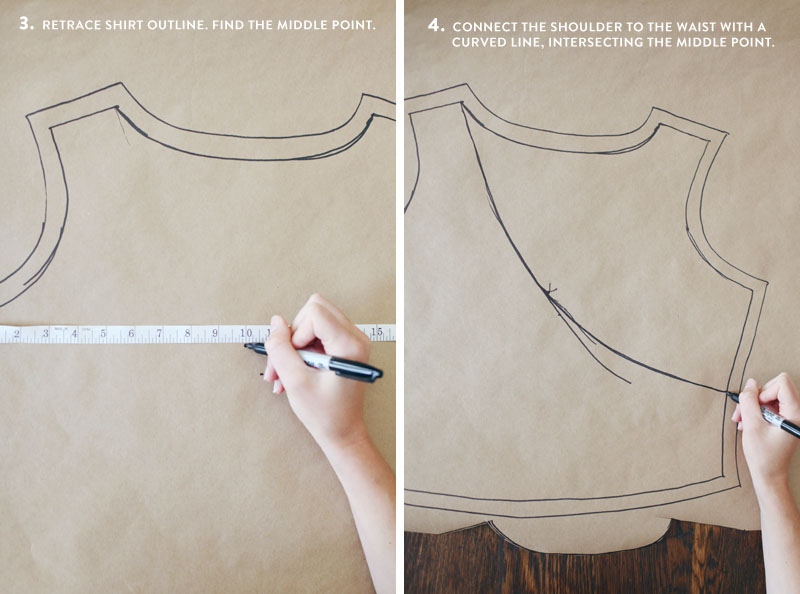
Step Three: Trace the pattern from step two, and indent the outline of the 1/2″ hem allowance. Find the middle of the piece between the armpits.

Step Four: Draw a curved line from the inside, top of the shoulders to the waist, just about 3-4″ from the bottom. Make sure the line you draw intersects the middle point you marked in step three. Cut out the paper along the curve, flip the paper up-side-down and trace it to create the other side of the back.

Make your own sewing pattern for a custom wrap top. Step by step photos of sewing process included!

Step Five: I got a little creative with the neckline by making a ’50s style v-shape. I also created extension pieces for each of the back wrap pieces, each measuring 19″ in length. I decided on their length by having a friend hold ribbon pieces at my waist, tying them comfortably at the front of my waist, and trimming the excess ribbon. Each piece measured 19″ long.

Make your own sewing pattern for a custom wrap top. Step by step photos of sewing process included!

Step Six: Pin the pattern pieces onto your both layers of coordinating fabric and cut out each piece. Make sure as you stack the coordinating fabric that the right sides are facing each other or away from each other. I laid out my pattern pieces on the bias (diagonally) so the fabric would stretch a bit against my curves. I was able to get the back wrap pieces and their extensions all in one piece, instead of cutting out the extensions separately and connecting them.

Make your own sewing pattern for a custom wrap top. Step by step photos of sewing process included!

Step Seven: Begin the process of making bust darts by finding the middle part of the front piece. Then measure out 4″ from the middle point on each side. This is the measurement I used to make my darts after holding the fabric to my body and judging where they should go.

Make your own sewing pattern for a custom wrap top. Step by step photos of sewing process included!

Step Eight: Measure 1.25″ out from the points you just marked in step seven. This will be the width of your darts.

Step Nine: Place a dot in between the two dots from step eight, then measure up 5″. Connect the dots to create the lines for the darts.

Make your own sewing pattern for a custom wrap top. Step by step photos of sewing process included!

Step Ten: Create darts using a similar technique on the sides of the front piece. Again, I measured my darts according to my own body, but if you are similar to me, you may want to measure 5″ down from the armpit hole for the top line of the dart. Then go down 1.25″ for the bottom line of the dart. The point of the dart was positioned 1″ above the point of the bottom darts, as shown in the above image. Connect the top, middle, and bottom lines of the dart to the point.

Make your own sewing pattern for a custom wrap top. Step by step photos of sewing process included!

Step Eleven: Iron the darts so that the crease is right at the middle line of each dart. Then stitch along the outside lines of the darts. Then Iron them flat.

Make your own sewing pattern for a custom wrap top. Step by step photos of sewing process included!

Step Twelve: Begin assembling the top by placing the back wrap pieces face-to-face onto the front piece. Pin along the shoulders and sides and stitch together, 1/2″ from the edge. Then iron the hems flat to prevent bulk when assembling the entire pieces in the next step. You may be able to see that I also sewed darts into the back wrap pieces for an extra fitted design, but it’s really not necessary due to the wrap style.

When you are finished connecting the pieces, make sure it fits you properly. If it doesn’t, you’ll need to make the proper adjustments before continuing.

Make your own sewing pattern for a custom wrap top. Step by step photos of sewing process included!

Step Thirteen: After you’ve completed steps 1-12 with a coordinating fabric (make sure the patterns don’t show through each fabric), fit the pieces together carefully, face-to-face. At this point you are checking to make sure the armpits and shoulders match up. This is why you need to cut both fabrics at the same time and stitch precisely 1/2″ from the edge of the fabric. If they don’t match up at this point, you will need to rip out the hem and correct the fit of one of the pieces.

Pin together the pieces along the neckline, reaching all the way to the ends of the wrap extension pieces. Then stitch 1/2″ from the edge.

Make your own sewing pattern for a custom wrap top. Step by step photos of sewing process included!

Step Fourteen: Cut little slits along the neckline and other curved areas where you have stitched. This will prevent puckering after you flip the piece right-side out.

Make your own sewing pattern for a custom wrap top. Step by step photos of sewing process included!

Step Fifteen: Now pin along the bottom edge of the two pieces and stitch them together everywhere except along the front. This open part is where you will flip the piece right-side-out in the next step.

Make your own sewing pattern for a custom wrap top. Step by step photos of sewing process included!

Step Sixteen: Now you can flip the top right-side-out through that opening you left in the previous step. Use a capped pen to help you with the pointy ends of the wrap extension pieces. Now iron along the hems to flatten it out. Flip under the open section of the front and iron along with the rest of the bottom hem.

Make your own sewing pattern for a custom wrap top. Step by step photos of sewing process included!

Step Seventeen: Pin along the opening of the front, where you just ironed, and then stitch it closed, very closely to the edge of both layers of fabric.

Make your own sewing pattern for a custom wrap top. Step by step photos of sewing process included!

Step Eighteen: Cut little slits long the armholes to prevent puckering after finishing them.

Make your own sewing pattern for a custom wrap top. Step by step photos of sewing process included!

Step Nineteen: Fold under the fabric along the armholes, ironing as you go along. Work one fabric side at a time.

Step Twenty: After each fabric side has been folding under at the armpit holes, each fabric side’s edge matching up, pin the two faces together and then stitch very closely along the edge.

I hope to get a lot of wear out of this top through the Summer— with high waisted shorts, skirt, and even over top of dresses. Yep, it’s a suitor!

 Older