Funny Face 1957

There’s something so magical about musicals from the ’50s that instantly makes my heart feel light and pushes any of my worries out of my mind. Maybe it’s the technicolor scenery, the Gershwin tunes, or the fact that even Fred Astaire can still play a leading man after 25 years in show business. But I’ll tell ya- this stuff is as magical as it gets!  I hadn’t seen Funny Face in many years and had forgotten what a delight it is. From the opening credits to even Audrey Hepburn’s solos, I adore this movie!

Dick Avery (Fred Astaire) is a seasoned fashion photographer working for a leading women’s magazine, Quality. But the newest issue of Quality Magazine seems to be lacking something, and the editor isn’t sure what. They try taking the models out of the studio and into a bookstore for a change of scenery, turning the place upside down and infuriating the skinny little shopgirl, Jo (Audrey Hepburn), who has to clean up their mess. Dick stays to help her and becomes impressed with Jo’s “funny face” (give me a break, right?!) and sharp mind. When the editor decides the magazine needs to find an every day women to be the face of the magazine, or The Quality Woman, Dick suggests Jo for the part.

But Jo has no interest in fashion, as she would rather have her head stuck in a philosophy book. They finally convince her to model for them by promising her a trip to Paris, where she can have the chance to meet the French philosopher she idolizes, when she’s not working at a photo shoot. Dick and Jo begin to fall in love through the coarse of their photo shoots, but things start to go wrong when Jo finally meets that French philosopher, and finds that he’s actually a younger, quite good looking man. And she won’t believe Dick when he says that the philosopher is interested in more than her brains.

I think I first fell in love with Funny Face as a little girl, because the dramatic Cinderella makeover plot always fascinated me. Of course, it’s really  a little silly, because Audrey Hepburn never looks dowdy even before her couture makeover. But as My Fair Lady proves, it’s hard to resist an Audrey Hepburn makeover story, right? Now that I’m older, I still enjoy a Cinderella story, but I was pleased that while Jo dons pretty dresses for the magazine shoots, she doesn’t give up who she was, and even a 1950s movie doesn’t make bookish women appear undesirable.

One of the main draws of Funny Face is the impeccable styling of each scene, and, of coure, the fashion! Oh, the fashion! It’s such fun. I also enjoyed the cultural comedy, pitting the French beatniks against the corporate couture-pushing Americans. There’s a lot of humor to be found in that- humor that’s still relevant today! (Think: hipsters and yuppies collide!) It’s a great movie, fun for the whole family, and even if you’ve seen it before, you should watch it again!

Divorce American Style 1967

The 1960s was the decade when divorce started to become pretty common in American neighborhoods and communities- and not just in the movies. This particular film isn’t exactly what you’d call a romantic comedy. More like a realistic dark comedy. Not dark as in lots of blood or bizarre circumstances, but dark, as in this movie probably hits home for a lot of couples and families. Some of it might seen funny, though it’s really too realistic to be hysterical. Divorce American Style pits two types of families against each other- one type is sort of a satirical commentary on marriage in the late ’60s, and the other is an example of how difficult and unnecessary a breakup can be.

Richard and Barbara Harmon (Dick Van Dyke and Debbie Reynolds) are like any couple that has been married for a while. They’ve got caught in a crazy cycle of the wife not respecting her husband in the way he wants to be, and likewise the husband not loving the wife as she wishes to be. Richard has finally become a successful provider, giving his wife more than she had ever wanted, materially speaking. But Barbara just doesn’t feel as happy as she was when they were young and money was tight. Their frustrations with each other bleed into every other area of their life- and their friends certainly aren’t helping.

Richard’s friend encourages him to have an affair, and Barbara’s friend seems so excited about the prospective drama of a divorce and encourages her to talk to a divorce lawyer. Next thing Richard and Barbara know, their marriage is spinning out on control and divorce papers are in the works. But is this really what they want, or are they being strung along by others who have bought into the new cultural norm?

Divorce American Style is, to me, a dramatic comedy. There sure is lots of drama, but nothing seems to be treated very seriously. Even the kids don’t seem to think their parents breaking up is a big deal. But fortunately, Richard and Barbara seem pretty surprised by everyone’s cavalier attitudes. There’s comedic plot elements in the movie, to be sure, but divorce treated as comedy is always a thin line to skate, in my opinion. I think this movie pulls it off well, though from a relational standpoint, I wasn’t too happy with how it all ended. It would be nice to see a movie where the couple actually learns how to rectify with their differences, instead of just living with problems or ditching the whole thing. But, I do like this movie, and I think Van Dyke and Reynolds are just delightful to watch!

The Way We Were 1973

I had a hard time thinking about what I wanted to say to you about this particular movie. It’s deeply touching, but I have a really difficult time figuring out why that’s so. The Way We Were is a classic romance filled to the brim with heartache, hope, and nostalgia. Thinking about this movie always conjures up images of a girls’ night in with tissue boxes and a bowl of cookie dough that never made it into the oven. But just as men can also enjoy eating raw cookie dough, I think they can enjoy this movie too! I’ll tell you a bit about the movie and why it’s a perennial favorite of mine.

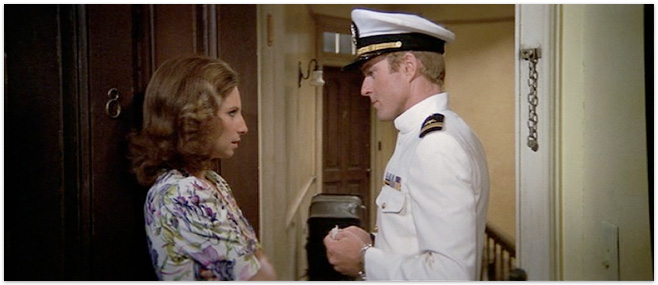
The movie begins sometime after World War II when Katie (Barbara Streisand) and her coworkers head out to a nightclub where she sees her college crush, Hubbell(Robert Redford), sitting asleep at the bar. In their school days, the two of them couldn’t have been any more different. Katie was involved with the young communist league and politics and social justice drove her every thought and action. Hubbell was an All-American athlete who never took things too seriously. He had a beautiful girlfriend, popular friends, and an ease for success in school. The two of them had a kind of fascination with each other back then, but certainly never became romantically involved. Now, years later, Katie sees her chance when she brings Hubbell home with her from the nightclub. To her disappointment, nothing happens that night, but she awkwardly lets Hubbell know that he is always welcome to stay with her when he’s home on leave from the Navy.

Hubbell does come stay with Katie again, and the two begin to fall desperately in love. They talk about his writing and she encourages him in ways he always needed. But they can’t survive in a bubble, and when they spend time with Hubbell’s friends, it becomes increasingly clear that neither of them have really changed since college, and their lives really don’t fit together at all. In desperation for Hubbell after they break up, Katie basically gives up her interest in politics in order to hang on to her love. And that’s when things seem to start going better for the two of them. For a while, that is.

The plot of The Way We Were revolves completely around the interactions between Katie and Hubbel- their ups, their downs, their frustrations, their joys. Streisand and Redford take to their parts so well, they really bring you right along on their roller-coaster of a relationship. The movie dodges the fluff of a happily-ever-after story and looks deeply into human nature- how when young love is given a chance later on in life, the two participants are hopeful and naive enough to believe that the reasons that kept them apart all those years ago won’t work against them now. Sometimes people don’t change, just their circumstances do. That’s how it worked for Katie and Hubbell, and anyone who has ever loved and lost can probably relate. And that’s why you might want to bring a box of tissues.

 Older